AI Visibility Data Collection Methodology
 Ask ChatGPT
 Ask Claude
 Ask Perplexity
 Ask Copilot
This page documents how Spyglasses collects and processes the data behind every number in your AI Visibility dashboard — which platforms we query, how we query them, what we count as a mention or a citation, and how each headline metric is calculated.
We publish this for the same reason we publish our AI Placement Value Score, AI Placement Quality Score, and Citation Optimizer methodologies: a visibility metric you can't audit is a metric you can't act on. Where a number has a caveat, we state the caveat. Where a signal is unavailable on a platform, we say it's unavailable rather than filling the gap with an estimate.
How Spyglasses Collects Data From Each AI Platform
Spyglasses collects from five AI answer platforms. Three of them (ChatGPT, Google Gemini, and Google AI Overviews) are covered by daily prompt tracking on every plan. Claude and Perplexity are covered in every AI Visibility Report, and each can be added to daily tracking as a paid add-on for a property (see Platforms and models we don't track by default). We collect from each one in the way that most closely reproduces what a real prospect would see, which means two different collection modes depending on what the platform allows.
Table: Spyglasses AI platform data collection methods. For each AI platform, this table lists whether it is included in daily prompt tracking, how Spyglasses runs the prompt (anonymous web interface vs. official API), which model version answers, how location targeting is applied, and whether the platform exposes the grounding searches it ran.
| Platform | In daily prompt tracking | Collection method | Model used | Location targeting | Grounding searches exposed |
|---|---|---|---|---|---|
| ChatGPT | Included | Logged-out, anonymous web interface | Current free-tier model at run time | Geo-located request + location in prompt | Yes |
| Google Gemini | Included | Logged-out, anonymous web interface | Current free-tier model at run time | Geo-located request + location in prompt | Yes |
| Google AI Overviews | Included | Logged-out, anonymous search results | Whatever Google serves for that query | Geo-located request + location in prompt | No — not exposed by the platform |
| Claude | Paid add-on | Official API | claude-opus-5-5 (pinned) | Passed to its search tool | Yes |
| Perplexity | Paid add-on | Official API | Pinned model (see table below) | Location in prompt + passed to its search tool | Yes |
Why two collection modes
ChatGPT, Gemini, and AI Overviews are run through the platform's own interface, logged out and unauthenticated. No account, no history, no memory, no personalization. This is deliberate: an answer generated for a signed-in user with months of chat history is not the answer a new prospect sees. A logged-out session is the closest available proxy for a first-time buyer researching your category. Because we use the public interface, these platforms answer with whatever model they currently serve to free-tier users — we do not and cannot pin a version. When the platform silently upgrades its default model, your data reflects that change, because your prospects experience that change.
Prompts on these three platforms can optionally be run through a residential connection in a location you specify, so a query about "dentist near me" resolves against the market you actually operate in. Claude and Perplexity are queried over an API and so cannot be geo-located this way. For Perplexity the location is supplied twice: as context in the prompt, and as a location hint on the request to the model's own web search tool. For Claude it is supplied only as that search tool hint, because Claude is asked the prompt exactly as written (see below). Either way it is a weaker signal than a geo-located session, because it tells the model where you are rather than making the request itself originate there. See Locations for how to configure this.
Claude and Perplexity are run through their official APIs. Neither platform offers a logged-out free tier we can run a prompt through reliably — Claude requires an account, and Perplexity restricts anonymous use. Rather than skip these platforms or scrape them in ways that would be fragile and against their terms, we query them through the documented API.
An API call has no notion of "a person typing a question into a box," and we handle that differently on the two API platforms.
Claude is asked the way a claude.ai user asks. Claude answers on claude-opus-5-5, the model claude.ai uses by default, at medium effort and with up to 10 web searches. We send your tracked prompt exactly as written, with no system prompt. We chose this setup from our own study of Claude's API against claude.ai, which compared seven API setups with claude.ai on the same buying questions. Opus 5.5 with no system prompt stayed within our tolerance for which brands it named. Every Sonnet setup fell outside it, including the Sonnet request with a system prompt that we used before. claude.ai still has its own system prompt and features an API call lacks, so this is a close match rather than a copy.
Perplexity gets a system prompt that establishes that context. It frames the model as an assistant giving recommendations to someone researching a purchase, adapts its emphasis to the category (software, retail, local services, and so on), and instructs it to search the web and cite what it finds. This is intended to reproduce the behavior of the prospects your clients most want to reach: people asking an assistant which solution to buy. It is not a neutral, context-free API call, and we would rather say so than imply an equivalence with the UI-based platforms that doesn't exist.
Because Claude and Perplexity are collected via API (Perplexity with a system prompt), and ChatGPT, Gemini, and AI Overviews are collected from anonymous UI sessions with no system prompt, cross-platform comparisons have a methodological asymmetry. Comparing your ChatGPT share of voice to your Claude share of voice compares two differently-produced samples. Trends within a single platform over time are the more reliable read.
Platforms and models we don't track by default
Claude and Perplexity are not part of daily prompt tracking by default. Neither has an anonymous interface we can query, so every run is a metered API call against a paid account. That cost grows with every prompt, every location, and every day we run it. Rather than fold it into the price of every plan, we price it as an add-on: both platforms are included in every AI Visibility Report at no extra cost, and you can add either one to daily tracking for an additional fee.
Add-ons are set per property, so you can turn one on for the properties that need it and leave the rest on the base platforms. Perplexity daily tracking is available on any plan. Claude daily tracking is available on request. See pricing for add-on details, or contact us to add one.
The same applies to platforms we don't cover in the base product at all — Copilot, DeepSeek, a specific model version, or a reasoning tier above the free default. Contact us to scope any of these.
How Often Prompts Run
Tracked prompts run once per day, at 06:30 UTC. The daily run covers ChatGPT, Gemini, and Google AI Overviews, each through an anonymous interface (see Why two collection modes above).
Claude and Perplexity are an add-on to daily tracking rather than a default part of it. Where the add-on is enabled for a property, they are queried through their official APIs in the same daily pass and appear alongside the other three everywhere in your dashboard. Either way, both platforms run inside every AI Visibility Report, which you trigger on demand or schedule.
A weekly maintenance pass (Sundays, 07:00 UTC) refreshes SERP rankings for your grounding searches and harvests Gemini fan-out queries. Brand accuracy is re-scored monthly (1st of the month, 07:00 UTC) — it moves slowly enough that a weekly cadence added cost without adding signal.
The same prompt does not produce the same answer twice
This is the single most important thing to understand about all AI visibility data, ours included. These models are non-deterministic. Run the identical prompt twice and you may be mentioned once and not the other time — with no change to your website, your competitors, or the model.
This means a single day's result is a sample, not a measurement. A brand that appears in 6 of 10 runs has a true mention rate somewhere near 60%, but a single run tells you only "yes" or "no." Confidence comes from accumulating observations over time.
We publish the statistics for this openly, including the formula, in our AI visibility data reliability calculator. We use the normal-approximation binomial confidence interval:
Ten prompts tracked daily produces 300 observations per platform per month, for a margin of error of roughly ±4.7% at 90% confidence. Three prompts tracked daily produces 90 observations and a margin of roughly ±8.7% — directional, but not a number you should report as precise.
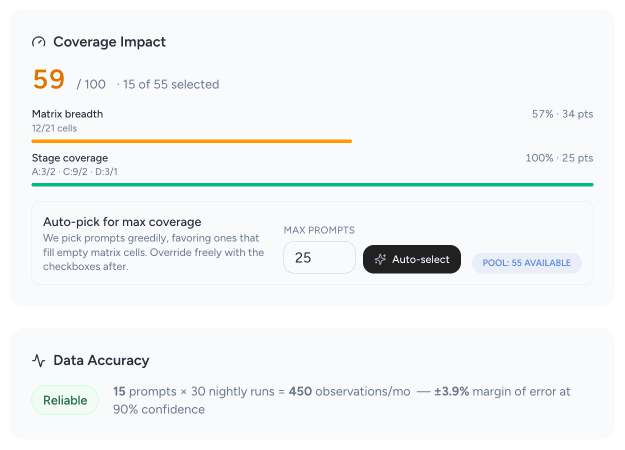
We show you this before you spend anything. When you add prompts to a project, Spyglasses displays the resulting observation count, margin of error, and a quality rating (Reliable under ±8%, Directional under ±15%, Exploratory above that) while you are still choosing how many prompts to track — not after you've paid for a number that can't support the conclusion you want to draw from it.
Our Commitment to Data Provenance
Every prompt Spyglasses runs and analyzes on your behalf is one you explicitly asked us to run.
Some vendors in this category populate dashboards from prompt databases rather than from prompts their customers requested. Those databases are typically sourced one of two ways:
- Harvested clickstream data — acquired from third-party tools such as free VPNs, browser extensions, or "free" analytics products that record what their users type into AI assistants, and resell it.
- Synthetic prompts generated at volume from proxy data — inflating a small seed set into thousands of prompts derived from signals like Google's "People Also Ask," then presenting the resulting volume as observed demand.
Spyglasses will never acquire, use, resell, or advocate for either. The first is built on data collected from people who did not meaningfully consent to having their AI conversations sold. The second dresses up a guess as a measurement. Neither belongs in a dataset a client is going to make budget decisions from.
Everything downstream of that commitment is auditable:
- Raw prompt data is always available for inspection in the platform. For any prompt, on any run, you can read the full answer text the AI returned, every citation it produced, and every brand it named.
- You can export it on demand, at any time, in full.
- We do not filter, curate, or reweight the prompt set to improve how your results look.
How We Detect Brand Mentions
Brand mention detection is deterministic string matching — your brand name, plus any number of aliases you configure, matched case-insensitively at word boundaries against the AI's answer.
We do not use an LLM to judge whether your brand was mentioned. This is a deliberate trade. An LLM judge can catch a paraphrase that a string match misses, but it introduces non-determinism into the one layer of the pipeline that most needs to be reproducible: two runs of the same judge over the same answer can disagree, which means your share of voice could move without your visibility moving. Deterministic matching means any mention we counted, you can find yourself in the raw answer text — and any mention we missed, you can capture by adding an alias.
- Matching is case-insensitive and respects word boundaries, so "Acme" does not match "Acmeworks."
- Aliases are yours to control. Product names, legal entity names, common misspellings, abbreviations, former names. If AI describes you in a way our matcher misses, an alias fixes it permanently.
- Competitors work identically — each competitor has its own name and alias list.
Changing an alias recalculates your history immediately
When you add or remove an alias, rename your brand, or change your competitor set, Spyglasses recalculates your historical brand mention metrics in real time. Every stored metric row — mentions, share of voice, citation counts, per-platform breakdowns — is rewritten against the new alias set.
This works because we retain every raw AI answer. Recalculation re-matches the new alias list against the stored answers; it does not re-run any prompts and does not cost you anything. The practical effect is that adding an alias six months in retroactively corrects six months of history, rather than creating a discontinuity in your chart on the day you added it.
Spyglasses Core Metric Definitions
The atomic unit of measurement is a platform execution: one prompt, run against one platform, once. A report covering 10 prompts across 5 platforms produces 50 platform executions.
Table: Definitions of core Spyglasses AI visibility metrics. For each headline metric in the Spyglasses dashboard, this table gives the precise formula and the unit it is calculated over.
| Metric | Definition | Formula |
|---|---|---|
| Brand mention | Your brand (or an alias) is named in the text of the AI's answer. | Deterministic word-boundary string match |
| Share of Voice | The percentage of platform executions in which your brand is named in the answer. | executions where brand appears ÷ total completed executions × 100 |
| Share of Influence | The percentage of awareness-stage answers that reflect your positive key messages, whether or not you're named. | Mean of the match rates of your positive key messages |
| Citation rate | How often your domain is cited, relative to how many chances it had. | citations of your domain ÷ total completed executions × 100 |
| Total mentions | The count of platform executions in which your brand appears. | Count of executions, not count of name occurrences |
Three of these need a caveat stated plainly.
Share of Voice is a presence rate, not a zero-sum split
Our Share of Voice answers: "of all the times we asked, how often did AI name you?" The denominator is the number of prompts we ran, not the number of brands named.
This means Share of Voice does not sum to 100% across you and your competitors. If an AI answer recommends five tools and you're one of them, you get credit for that execution — and so do the other four. It is entirely possible for you and every competitor to each hold 90% share of voice, if AI keeps naming all of you.
Some vendors define share of voice as a zero-sum split of total mentions (your mentions ÷ everyone's mentions). That number has a real weakness: it falls when a competitor is mentioned more, even if you are mentioned in exactly as many answers as before. We chose the presence-rate definition because "am I in the answer?" is the question that maps to a decision, and because it can't be gamed by a competitor's noise. If you're comparing a Spyglasses Share of Voice against another tool's, confirm which definition they use — they are not interchangeable.
Share of Influence measures narrative, not naming
Share of Voice asks whether you were named. Share of Influence asks whether your framing of the category showed up before any brand was named — the awareness stage, where an AI is explaining what matters in a category rather than recommending vendors.
It is calculated by embedding each of your positive key messages and each sentence of the AI's answer using text-embedding-3-small, scoring them with cosine similarity, and counting a match when a sentence clears a 0.50 similarity threshold. The threshold is calibrated: at 0.40, sentences that merely shared a topic with a key message were matching. At 0.50, a sentence has to actually express the idea. Share of Influence is then the unweighted mean of the match rates across all of your positive key messages.
This is a genuinely different signal from mentions. A brand can have low Share of Voice and high Share of Influence — AI has absorbed your argument about what matters in the category, but recommends someone else. That gap is usually the most actionable thing on the dashboard.
Citation rate can exceed 100%
The numerator counts citations; the denominator counts executions. An answer that cites two different pages on your domain contributes two citations from one execution. A citation rate above 100% means AI is citing you more than once per answer, on average — which is a good outcome, not a bug.
What we do not measure
We do not run sentiment analysis on how AI answers describe your brand. We could, but a sentiment classifier over an AI answer is an LLM judging an LLM, and we haven't been able to make it stable enough that a score change reliably means something changed in the world. We would rather ship no number than an unstable one. (Sentiment is scored on PR placements, where the input is a fixed human-written article rather than a regenerated answer — see the AI Placement Quality Score methodology.)
We do not publish a position-in-answer ranking. We capture a rank when a platform exposes one, but availability differs so much between platforms and detection paths that a cross-platform "average position" would be comparing incompatible things.
How We Handle Citations
Every source an AI platform surfaces is stored, classified, and — where we can reach it — crawled.
Cited, evaluated, or search result
Not every source an AI looks at makes it into the answer. We record which:
| Type | Meaning |
|---|---|
| Cited in answer | The source is referenced in the response text a user actually reads. A true, visible citation. |
| Evaluated only | The assistant fetched and considered the source while composing its answer, but never referenced it. AI retrieval found your content and chose not to use it. |
| Search result | The source appeared in the assistant's underlying web search results but was not used in the answer. |
The distinction is derived per platform from what that platform actually reports: Claude and the AI Overviews panel tell us directly which sources they cited; for ChatGPT, Gemini, and Perplexity we check each source URL against the links present in the answer text.
"Evaluated only" is the most underused signal in the product. It identifies pages AI is reading but not crediting — usually a shorter path to a citation than creating something new.
What we store per citation
For every citation: the URL, page title, whether it's your domain, which brand the answer attributed it to, the citation type above, the page type and content format, and — once crawled — the author, publish date, and word count. Media type and publisher authority are stored at the domain level.
For how cited pages are classified into media types, authority tiers, and content formats, see the Citation Intelligence documentation.
We crawl cited pages and scan them for your brand
When we detect a citation, we make a best-effort attempt to fetch the page and scan its content for mentions of your brand and your competitors, using the same alias list. We try a direct fetch first and fall back to a rendering service for pages that block it. Some pages can't be reached at all — hard paywalls, aggressive bot protection — and we mark those rather than pretending we read them.
A brand mention found in a cited page's content is not a brand citation, and we never count it as one. It means the page AI read mentions you — but AI did not attribute that page to you in its answer. The AI did not tell the user your name.
This distinction matters, and we keep the two strictly separate in every metric. But the gap between them is useful in its own right: it's coverage you have already earned, that AI is already reading, and is not yet crediting you for. In the dashboard this appears as hidden earned media, and it's often the cheapest visibility win available — the page already exists and already mentions you, so converting it into an attributed citation is an editing problem, not a PR problem.
Grounding Searches and SERP Rankings
When an AI assistant answers a question, it usually doesn't search for your prompt verbatim. It decomposes the question into its own web searches — grounding searches, sometimes called fan-out queries — and builds its answer from those results. These are the queries that actually determine whether you get cited.
We capture grounding searches for ChatGPT, Gemini, Claude, and Perplexity. All four expose the searches they ran; for Claude and Perplexity, on the runs where we query them at all (every AI Visibility Report, and daily tracking only where the add-on is enabled). Google AI Overviews is the one platform that does not expose them, so we have none to report there — we would rather show you nothing than infer a query list the platform never gave us.
Because the AI reads the search results for these queries, its top results are the pool it can cite from. So for every grounding search we capture, we run our own SERP and record where you, your competitors, and every other domain rank:
| Search engine | Grounding searches from | Depth tracked |
|---|---|---|
| ChatGPT, Gemini | Top 30 results | |
| Brave | Claude | Top 20 results |
Claude grounds its web searches in Brave rather than Google, so a Google ranking tells you little about whether Claude can find you. We run Brave for Claude's searches specifically. Brave's API returns at most 20 results, so Claude's SERP coverage is top 20 rather than top 30. If a search produced by Claude was also produced by ChatGPT, we run both engines against it. Perplexity is a third case: it retrieves from its own index rather than Google or Brave, and that index can't be queried from outside. We record the grounding searches Perplexity ran, but we run no SERP for them; a Google or Brave ranking would give a false picture of what Perplexity itself saw.
A domain that doesn't rank gets recorded with a null position — "not in the top 30" is itself a finding, and it's what drives gap analysis: grounding searches where competitors rank and you don't.
SERP rankings are re-checked weekly, up to 50 grounding searches per property per week. Properties with more than 50 tracked grounding searches have them refreshed in rotation rather than all at once.
How We Measure Brand Accuracy
Share of voice tells you whether AI names you. Brand accuracy tells you whether what it says about you is correct — the failure mode where you appear in every answer and are described as something you are not.
The eight-call design
We ask four AI platforms to describe your brand, twice each:
- Without web browsing — the model answers from its training data alone. This is what it "remembers" about you, and it's what a user gets when the assistant doesn't search.
- With web browsing — the model researches you first. This is what it says when it can read your site.
Four platforms × two modes = eight independent brand descriptions per scoring run. The two modes usually disagree, and the disagreement is the point: a brand that scores well with browsing and badly without has a training-data problem, not a website problem, and no amount of on-site optimization will fix it quickly.
Table: Spyglasses brand accuracy scoring platforms and models. These are the four AI platforms and specific model versions Spyglasses uses to score brand accuracy. Unlike the free-tier UI platforms, these models are pinned so that accuracy scores remain comparable over time.
| Platform | Model |
|---|---|
| ChatGPT | gpt-5.6-terra |
| Google Gemini | gemini-3-flash-preview |
| Perplexity | perplexity/sonar |
| Claude | claude-sonnet-5 |
Claude's brand accuracy model is not the model that answers your tracked prompts (claude-opus-5-5, see Why two collection modes). Brand accuracy stays on claude-sonnet-5 so that Claude accuracy scores remain comparable over time.
This table reflects the models configured in the Spyglasses platform as of the date on this page. We update it whenever we upgrade a model. Model changes cause step-changes in accuracy scores — a newer model with a more recent training cutoff frequently knows more about you — so we note them rather than letting a score jump go unexplained.
Model updates: On 2026-07-26, ChatGPT moved from gpt-5.3-chat-latest to gpt-5.6-terra and Claude moved from claude-sonnet-4-6 to claude-sonnet-5. Accuracy scores from runs before that date were produced by the previous models. On 2026-09-10, Perplexity moved from the retiring Sonar Chat Completions API (sonar) to the Perplexity Agent API (perplexity/sonar, the same model family). Perplexity answers from that date on are full markdown with inline citations, and we now record the grounding searches Perplexity ran. On 2026-10-02, Claude prompt tracking and AI Visibility Reports moved from claude-sonnet-5 with our system prompt to claude-opus-5-5 with no system prompt. Expect a step change in Claude share of voice and in the brands Claude names from that date. Claude brand accuracy did not change models.
How the score is calculated
Each of the eight descriptions is scored against your Brand Snapshot — the structured self-description Spyglasses builds by crawling your own website, and which you can edit at any time. This is important, and worth being explicit about: we are not scoring AI against some objective truth about your company. We are scoring it against what your own website says about you, as corrected by you.
Five fields are compared and weighted:
| Field | Weight | What it asks |
|---|---|---|
| Category | 25% | Does AI know what kind of company you are? |
| Features | 25% | Does AI know what you actually do? |
| ICP | 20% | Does AI know who you're for? |
| Differentiators | 20% | Does AI know what makes you different? |
| Pricing model | 10% | Does AI know how you charge? |
Category and pricing model are scored deterministically against a fixed decision table. Features, ICP, and differentiators are compared semantically — "helps teams collaborate on documents" and "document collaboration for teams" should score as a match, not a miss. That comparison is made by an LLM judge (gpt-5-nano) against a fixed rubric, with a deterministic string-similarity fallback if the judge fails.
The weighted result is a 0–100 score. Two behaviors worth knowing:
- If a model doesn't know your brand at all, the score is 0, not a low-but-nonzero number. An AI that has never heard of you is a categorically different problem from an AI that describes you inaccurately, and averaging them together would hide it.
- Penalties are applied for confident wrongness — describing you as being in the wrong industry, or attributing features you couldn't possibly have. Hallucinating a feature you don't have is worse than omitting one you do.
Known Limitations
We would rather you learn these here than discover them in a client meeting.
A daily result is a sample. See the reliability section above. Never report a single day's share of voice as a fact.
Cross-platform comparison is asymmetric. Where Claude and Perplexity are running, they are collected via API (Perplexity with a system prompt); ChatGPT, Gemini, and AI Overviews are collected from anonymous UI sessions without one. Trends within a platform are more trustworthy than differences between platforms.
Daily tracking and reports can cover different platform sets. Without the Claude/Perplexity add-on, your daily trend lines are built from three platforms while your AI Visibility Reports are built from five. A report's share of voice is therefore averaged over a different platform mix than the same week's daily chart — a gap between the two numbers is a difference in coverage, not a change in your visibility.
Model versions shift underneath us on the UI platforms — by design. We report what the platform currently serves, which means an unannounced model swap by OpenAI or Google will show up in your data as a step change that has nothing to do with your marketing. We use annotations to mark these when we detect them.
Logged-out is a proxy, not a mirror. Real users have accounts, chat history, memory, and personalization. We measure the unpersonalized baseline because it's the only thing that's measurable and comparable — but it is not the only answer any real person sees.
Deterministic matching misses paraphrase. If AI refers to you by a name that isn't in your alias list, we won't count it. This is why the alias list exists, and why we recalculate history when you change it.
Not every cited page can be crawled. Paywalls and bot protection mean content-mention coverage is a floor, not a total.
These metrics are directional signals, not guarantees. A high share of voice means AI is naming you today, in the answers we sampled, for the prompts you chose. It does not guarantee any specific person asking any specific question will see you.
Related
- Is Your AI Visibility Data Reliable? — The statistical confidence calculator, with the formula
- Citation Intelligence — How cited pages are classified
- Key Messages — How Share of Influence is configured
- Locations — Location-targeted prompt runs
- AI Placement Quality Score — How individual PR placements are scored
- AI Placement Value Score — How publishers are scored
- Citation Optimizer — How content is scored and rewritten for citation