ChatGPT Already Knows Your Domain. Here's What That Changes.

Jim Wrubel
9/14/2026

Here's a worry we hear a lot. When ChatGPT goes looking for your brand, does it actually know where you live on the web? Or does it take your name, bolt a .com onto the end, and hope? If it's guessing, every brand with a domain that doesn't match its name is one bad roll away from sending a user to someone else's site. And there's nothing you could do about it.
So we tested it. Our research team built a panel of 48 brands designed to catch a guesser, asked ChatGPT about each of them twice a day for ten days, and recorded the exact site: search it typed when it went to consult a brand's own website. The full study is pre-registered and the data is public. Here's what it means for you.
Key Takeaways
- ChatGPT keeps a stored list of brand domains and uses it when it scopes a search to a brand's site. It doesn't predict your domain from your name.
- When it consulted a brand's own site, it used the right domain in 100% of calls for brands with guessable domains, 98.6% for brands with non-obvious domains, 98.5% for brands that changed domains, and 100% for obscure brands, across 1,152 calls evaluated in this study.
- Out of 7,117 site-scoped searches, it typed a name-shaped guess twice, both for one brand on one call. Four calls in total landed on a different company's site.
- If you changed domains, the old one stays on the list. Meta's facebook.com and GoTo's logmein.com came back day after day, always alongside the new domain, never instead of it.
- The rare wrong-company mix-ups happened on comparison questions, where the model opens on competitors first. Your comparison content is where your identity gets tested.
It's a list, not a guess
The design was simple. Four tiers of twelve brands each. Tier A brands own their own name (Sony, Stripe, Figma). Tier B brands have domains you'd never guess from the name (Linear at linear.app, Motion at usemotion.com, Things at culturedcode.com). Tier C brands changed domains at some point (Notion, Meta, GoTo, Zoom). Tier D brands are real but obscure small-business tools most people have never heard of; if the model has to guess anywhere, it's here.
If ChatGPT were reconstructing domains from names, tiers B and D are where it would fall apart. Several of the "obvious" guesses are real sites owned by unrelated companies. bear.com sells mattresses. motion.com sells industrial parts. A guesser would walk right into them.
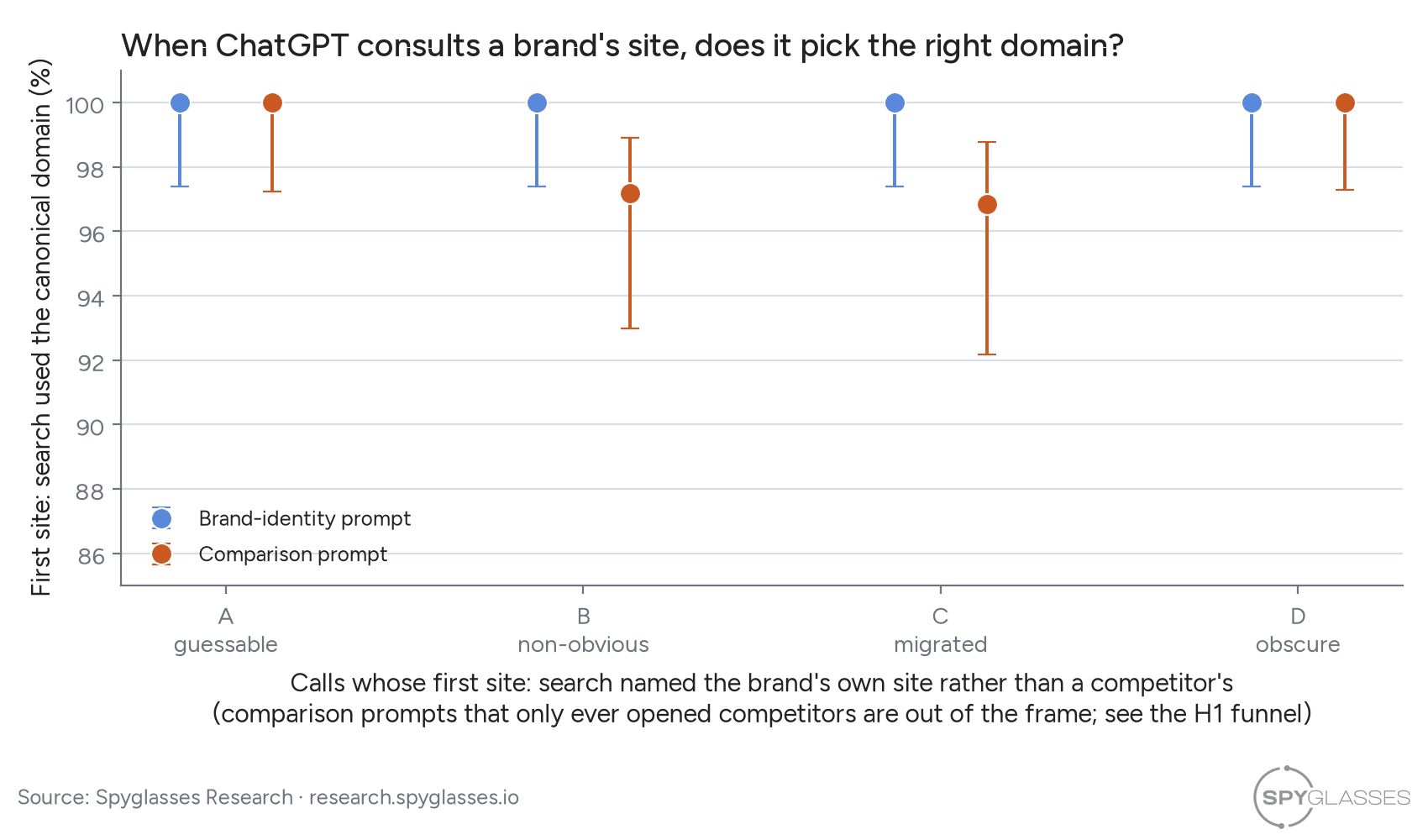
It didn't walk into any of them. Every brand-identity question, in every tier, on every one of the ten days, sent the model to the brand's true domain. All 576 of those calls. The obscure tier was perfect. The non-obvious tier was perfect on identity questions and slipped once on a comparison question. That's the behavior of a lookup table, not a dice roll.
The traps we set, and what they caught
Across the whole study, four calls out of 1,152 committed to a site that wasn't the brand's. Three of them went to amieapp.com while answering about Amie, the AI calendar app at amie.so. That's a different company that happens to share the name. One went to clockwise.com while answering about Clockwise, which lives at getclockwise.com. All four were comparison questions.
Every other non-canonical consultation in the study was one of two things: the brand's own previous domain, or another site the brand actually owns (Meta's investor site, GoTo's gotomypc.com, Shopify's developer docs). We checked each one by hand.
So the real failure rate for "ChatGPT went to the wrong company" is about a third of one percent. And our design could have caught a guess rate of about 1% per tier on identity questions if one existed. It didn't.
The one thing it doesn't forget
Here's the finding that should change your to-do list if you've ever rebranded or moved domains. The model didn't forget the old ones.
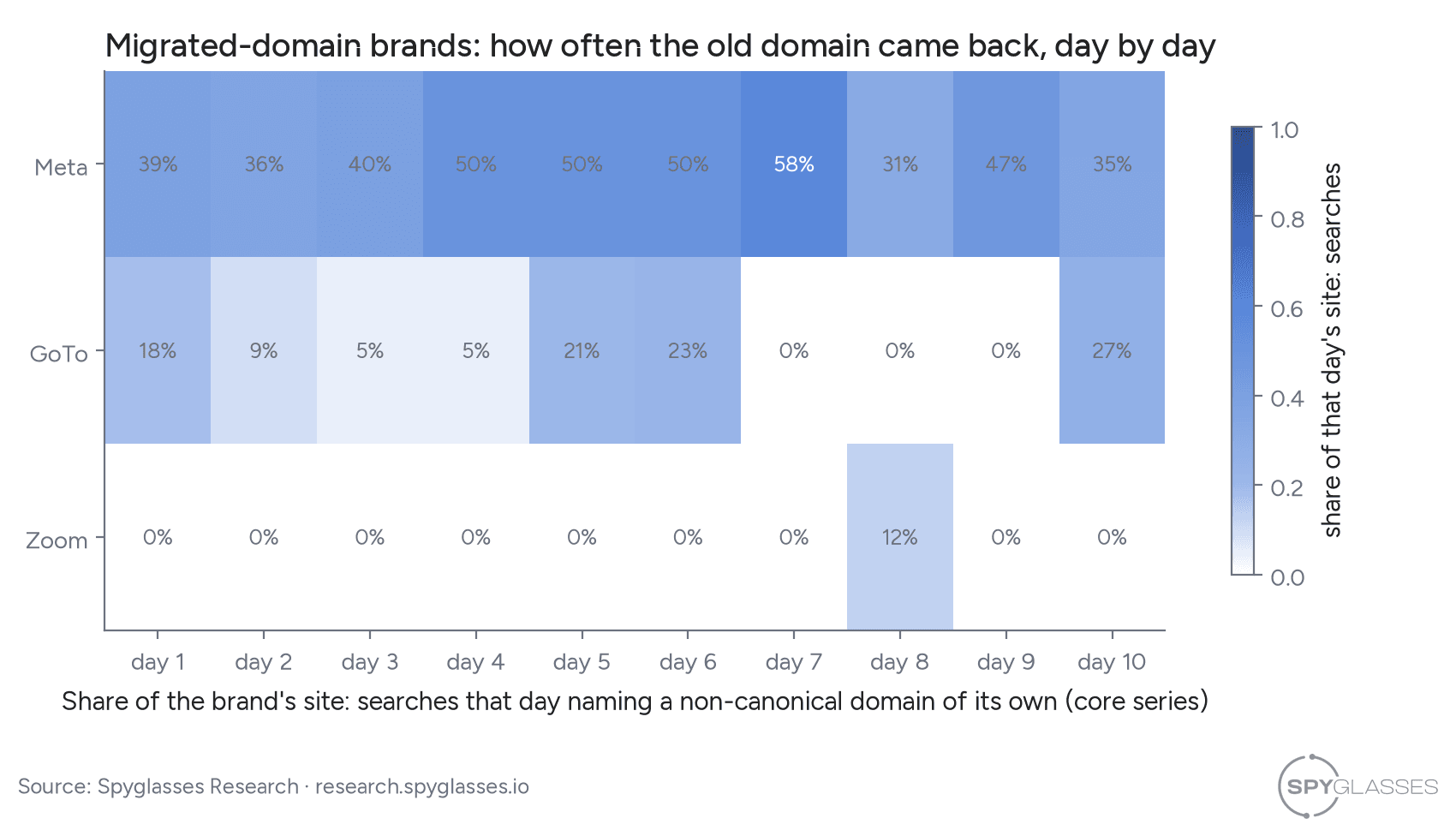
Meta moved from facebook.com to meta.com years ago. On all ten days of the study, between 31% and 58% of the searches ChatGPT scoped to Meta's own sites went to facebook.com or fb.com. GoTo's old domain, logmein.com, showed up on six of ten days. Zoom's old zoom.us showed up once.
The important detail: in every single one of those calls, the model also searched the new domain. It didn't pick the old address instead of the new one. It searched both. The list has two entries for the brand, and the model works through them.
That's good news and a chore. Good news because your new domain is on the list. A chore because your old one is too, and it will keep getting direct requests from the model for the foreseeable future.
What to do this quarter
If you've migrated domains, keep the old ones alive. DNS, TLS certificate, and a clean redirect to the equivalent page on the new domain. Not just the home page; deep links matter because the model scopes searches to specific paths like pricing and help pages. If the old domain goes dark, the model won't quietly drop it. It'll get nothing back from a site it still trusts. Our guide to tracking a rebrand in AI answers covers how to watch this over time.
If you share a name with a bigger company, anchor your category everywhere. The Amie mix-up happened on comparison questions, and the fix is on your side of the fence. "Amie, the AI calendar" in your page titles, your descriptions, and your comparison pages gives the model the anchor it needs to keep you separate from the other Amie. Cheap insurance.
Stop worrying about the front door and start worrying about the rooms. The model shows up at the right address. The real question is what it finds when it gets there. It's scoping searches to your pricing page, your features page, your help center. If those pages are thin, blocked to crawlers, or say something different from your positioning, that's what ends up in the answer. Our AI Readiness Site Audit scores exactly those pages for how well AI can read and cite them.
Put your effort into comparison content. Comparison questions are where ChatGPT opens on competitors first, where the wrong-company mix-ups happened, and where our previous study found the model most likely to consult primary sources. Factual, non-superlative comparison pages are the content most directly tied to that behavior.
What this doesn't mean
Every number above is "when the model chose to consult the brand's own site." We measured what it types when it does that, not whether it knows a domain it never chose to look up. It's one model (gpt-5.6-terra) through the OpenAI API, not the consumer app, and it says nothing about Perplexity, Gemini, or Google AI Overviews. And ten quiet days set an upper bound on guessing; they don't prove it can never happen.
The old-domain finding rests on three brands. It's a clear pattern, not a law, and the study says so.
The full methodology, the pre-registered hypotheses, the one test we couldn't identify from the data (and why we say so instead of swapping in one that would have passed), and the released dataset are all in the research article.
Want to see which of your pages AI consults directly, and whether it's reaching the right domain? Run an AI Visibility Report. The preview is free.