Your Claude Subscription Can Track Brands Like claude.ai Does

Jim Wrubel
11/10/2026

Claude is expensive to track. There is no logged-out version of claude.ai to sample, so tracked answers usually come from paid API calls, and the cost grows with every question and every day.
Many teams already pay for something else: a Claude subscription. Pro and Max plans include Claude Code, which can run questions on a schedule in Anthropic's cloud or on a computer, without anyone typing. That raises a simple question. If you run your tracking questions through Claude Code on your own subscription, do you get the brands a real person sees in claude.ai?
Claude Code isn't claude.ai. It has its own instructions, its own search tool and its own way of turning search results into an answer. So our research team tested it. The full study is pre-registered and the data is public. Here's what we found.
Key Takeaways
- A scheduled Claude Code task, set up carefully, named the same brands as claude.ai for B2B software buying questions, as closely as claude.ai agrees with itself from one day to the next.
- A local Claude Code run on a computer also came close on which brands it named, and was a little less faithful on the order it named them in.
- Scheduled and local Claude Code agreed with each other, so either can stand in for claude.ai on brands.
- Claude Code searches more often than claude.ai and cites a somewhat different mix of websites, yet it lands on similar brands.
- This approach is not suitable when search location matters, because Claude Code's web search can't be set to a location.
- claude.ai itself changed this fall. It now searches more and works more like Claude Code, so any stand-in should be checked against it again over time.
The study
The team reused 40 buying questions from our earlier Claude study, spread across 20 software categories such as CRM, payroll and endpoint security. One person typed every question by hand into claude.ai on three days in November, from a Pro account with memory and personalization off. claude.ai was the reference.
On the same days, the same questions ran unattended through Claude Code on a Max subscription, set up in three ways:
- A scheduled task in Anthropic's cloud, the setup that needs no computer left running.
- A local run with Claude Code's default settings.
- A local run with Claude Code's own instructions replaced by an empty set.
In total, 600 answers were evaluated in this study.
We compared which brands each answer named, using an overlap score: the share of brands two answers have in common, from 0 (nothing shared) to 1 (the same brands). The bar was claude.ai itself. claude.ai doesn't give the same answer twice, so we first measured how well it agrees with itself on the same question across days. A Claude Code setup passes if it agrees with claude.ai about as well as claude.ai agrees with itself. We call the shortfall the gap. Before collecting any data, we set the tolerance at 0.10, which for two answers naming about ten brands is roughly one brand swapped for another.
What we found
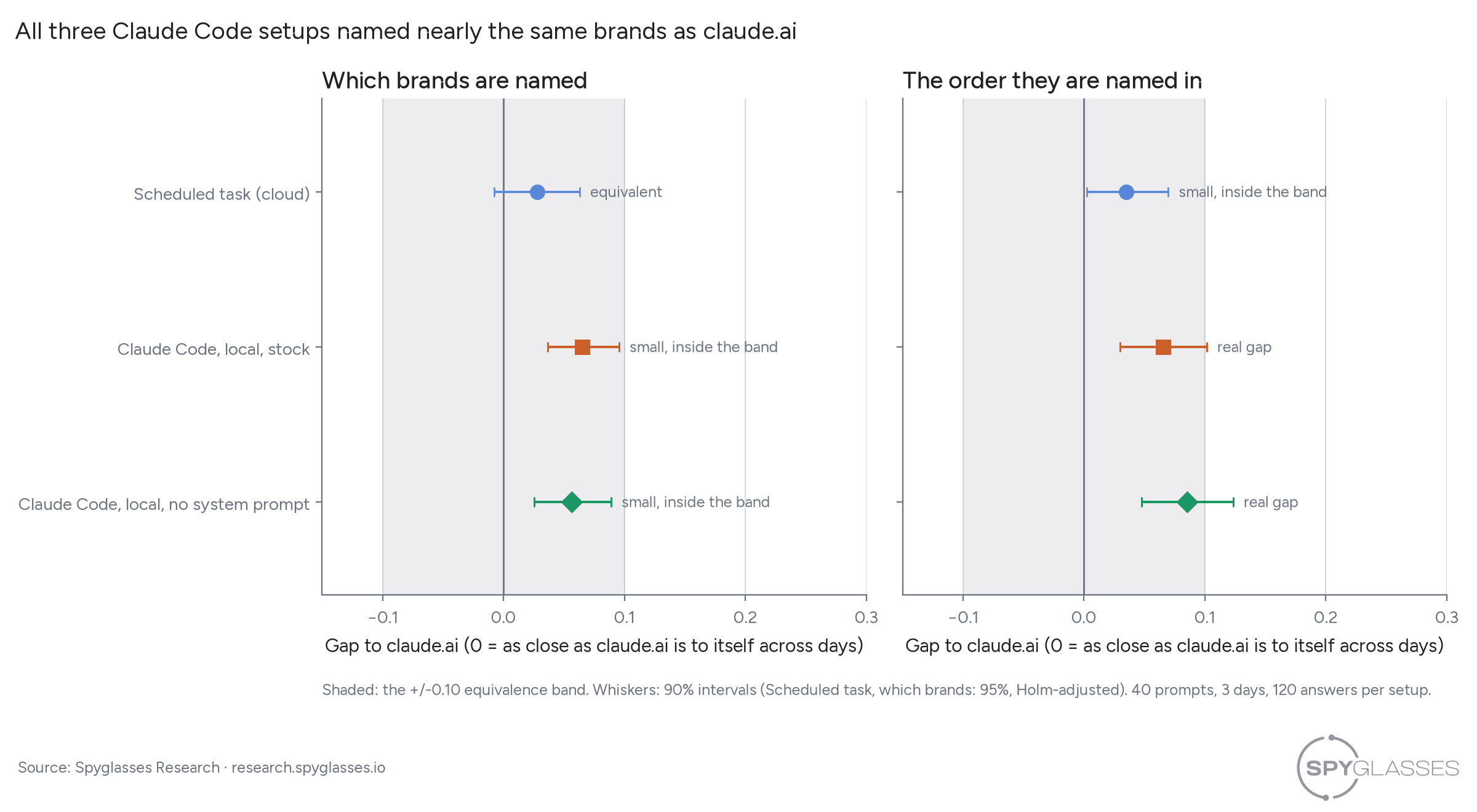
A scheduled task matched claude.ai
The scheduled task's gap was 0.028, which our pre-registered test treats as no difference at all. It named the same brands as claude.ai about as consistently as claude.ai names them itself.
How the task was built mattered. Pasting the questions straight into a scheduled task didn't work in our first tests: it answered from memory and skipped the search. The version that worked gives each question to a fresh helper agent with one short instruction to search the web and answer the person asking. It also turns off notifications and the connected apps a new task picks up by default.
A local run came close
Running the questions through Claude Code on a computer, with its default settings, gave a gap of 0.065. That is a small but real difference, still inside the tolerance. The brands matched. The order they came in matched less well: on a score that gives more weight to the brands named first, the local runs reached just past the tolerance, while the scheduled task stayed inside it.
If your reporting leans on position, such as which brand is named first, the scheduled task is the closer match.
Different searching, similar brands
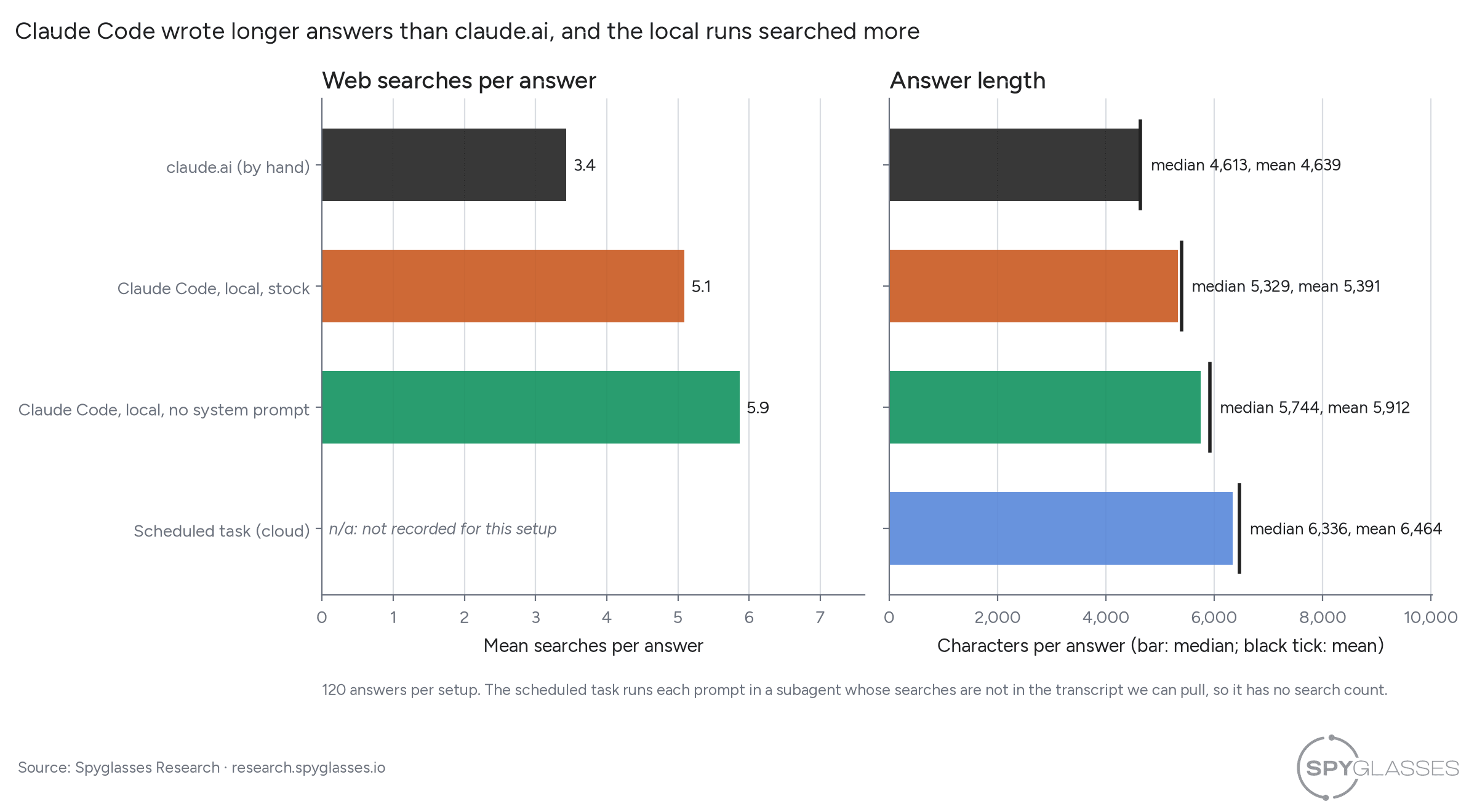
Claude Code worked harder than claude.ai. The local runs averaged 5 to 6 web searches per answer, against 3.4 in claude.ai, and wrote longer answers with more links. The websites they cited overlapped less with claude.ai's than the brands did. Even so, the brands came out close. For brand tracking, what you see from Claude Code is a good guide to what a claude.ai user sees. For tracking which sources Claude cites, read Claude Code's results as directional.
claude.ai changed while we watched
The same questions, on the same account, behaved differently in November than in our September study. claude.ai now runs about 3.4 searches per answer instead of 1.2, and every answer searched. In September, about one in six did not.
In September, Anthropic began merging claude.ai's chat with Cowork, and Cowork uses the same agent design that powers Claude Code. That this explains the change on our account is our reading, not something Anthropic has said. Either way, claude.ai can change within weeks. That's a good reason to check any tracking method against it more than once.
What this means for your Claude tracking
A subscription can be a credible source of Claude brand data. For B2B software questions, a carefully built scheduled task in Claude Code named the brands a claude.ai user sees.
Build the task carefully. Give each question its own helper agent, tell it to search the web, turn off notifications, and remove connected apps so your other tools don't leak into tracking runs.
Don't use it when location matters. Claude Code's web search has no location setting, and a scheduled task runs from a place you can't choose. For local services, regional vendors or anything where the answer depends on place, use a tracking method that can set the search location, such as the Claude API.
Watch the order, not just the list. If you report which brand comes first, prefer the scheduled task to a local run.
What this doesn't mean
The study covered 40 synthetic B2B software buying questions over three days, with one claude.ai account as the reference. The results may not hold for consumer products, local services, other languages or personalized accounts. It compared brands, not sources. Whether a given use of a subscription fits Anthropic's terms is a separate question from what this study measured.
The full method, the pre-registered plan and the released data are all in the research article.
Claude is included in every AI Visibility Report. Our data collection methodology explains how we collect from each AI platform. To talk about tracking Claude for your brands, contact us.