AI Has a List of Sites It Trusts. Here's How to Get On It.

Jim Wrubel
9/1/2026

When ChatGPT answers a question about your category, you probably picture it searching the web, weighing the results, and writing a summary. Most of the time, that's what happens. But sometimes it does something different. It skips the open web entirely and goes straight to one specific site, the way you'd call a friend who knows the answer instead of googling it.
These direct consultations show up in the grounding searches AI runs behind the scenes; a query scoped to a single site instead of the whole web. The behavior arrived in ChatGPT this summer, and plenty of people in the AI visibility space have noted its arrival. What nobody had done is look at who actually receives these consultations. We just published a study that classifies every one of them in our dataset. The results change how you should think about both content and PR.
Key Takeaways
- When AI consults a site directly, it's usually not the brand being asked about. 81% of direct consultations in this study went to third-party sites; only 8% went to the brand's own site.
- The trusted list is institutional. Government and court sites alone receive over a fifth of third-party consultations, and that holds even after correcting for our client mix. Reddit barely registers.
- The list is an authority club. Sites AI consults directly scored a median of 60 on our AI Placement Value Score versus 44 for sites AI cited but never consulted. Premium and Strong tier sites make up 62% of the consulted list versus 41% of the merely-cited.
- Comparison questions are the trigger. One in five brand-comparison answers included a direct site consultation; brand-identity and category questions sat at less than half that rate.
- The practical move for SEO: publish factual, non-superlative comparison pages. For PR: placements on consulted sites are worth more than their traffic numbers suggest.
Your AI story is told by references
Here's the number that should reframe your thinking: when AI decides to consult a site directly while answering questions in your category, there's an 81% chance that site is neither you nor a competitor you track. It's a third party. A regulator. A professional association. A review site. A vendor you've never heard of.
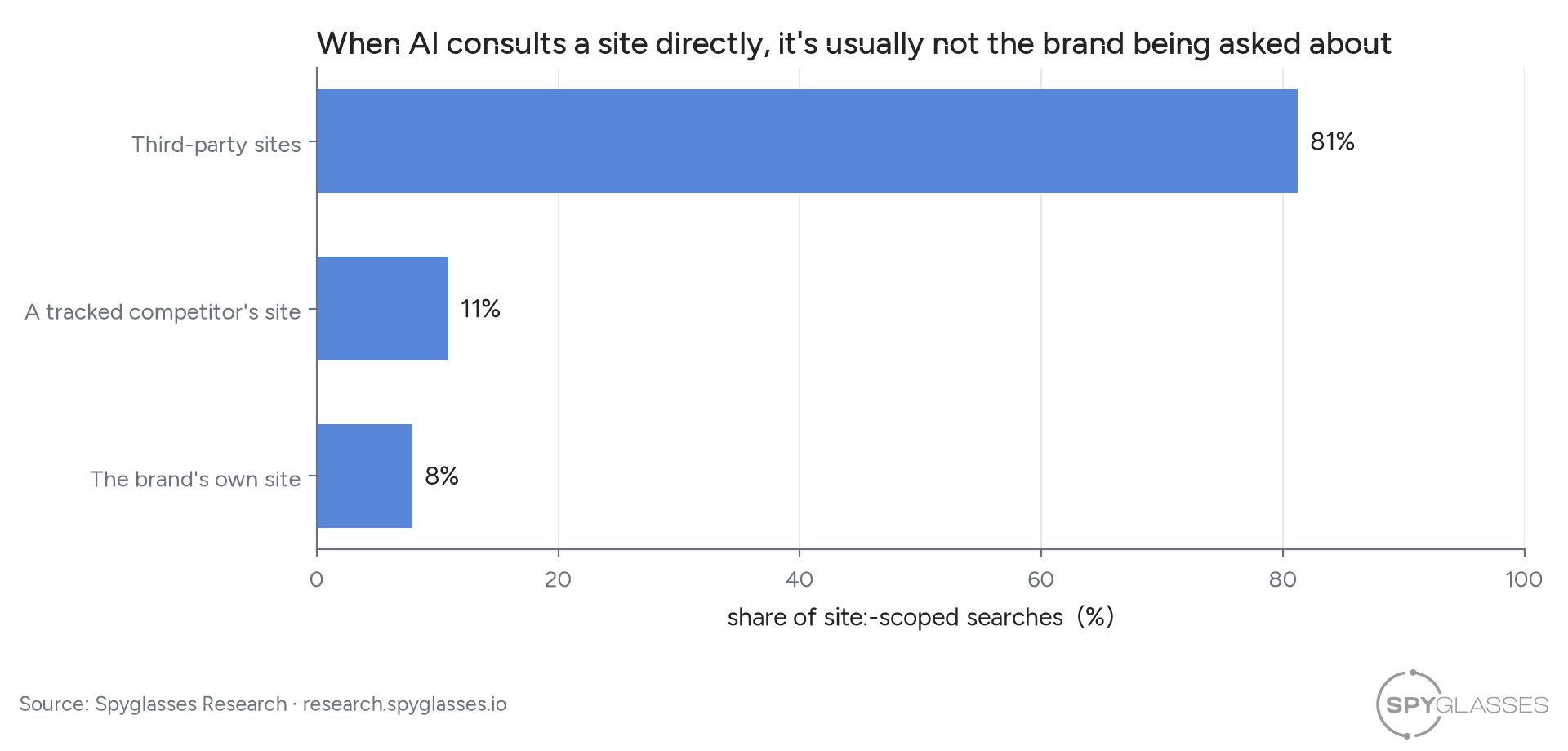
That means the sites AI trusts enough to ask directly are, overwhelmingly, sites you don't control. You can't optimize your way onto a government domain. But you can know which third parties AI treats as the authorities in your space, and you can make sure your brand shows up well on the ones that accept contributions, listings, or coverage.
And 11% of the time, the consulted site belongs to a competitor you're already tracking. AI went to their website for an answer that shaped a response about your category. If that doesn't make comparison content feel urgent, the next section will.
Who's actually on the list
We classified every consulted domain in the study into fourteen categories. The institutional lean is unmistakable: government and courts lead, followed by professional and industry associations, healthcare systems, and academic sources. Social platforms are almost absent; Reddit accounted for 0.14% of third-party consultations in this study.
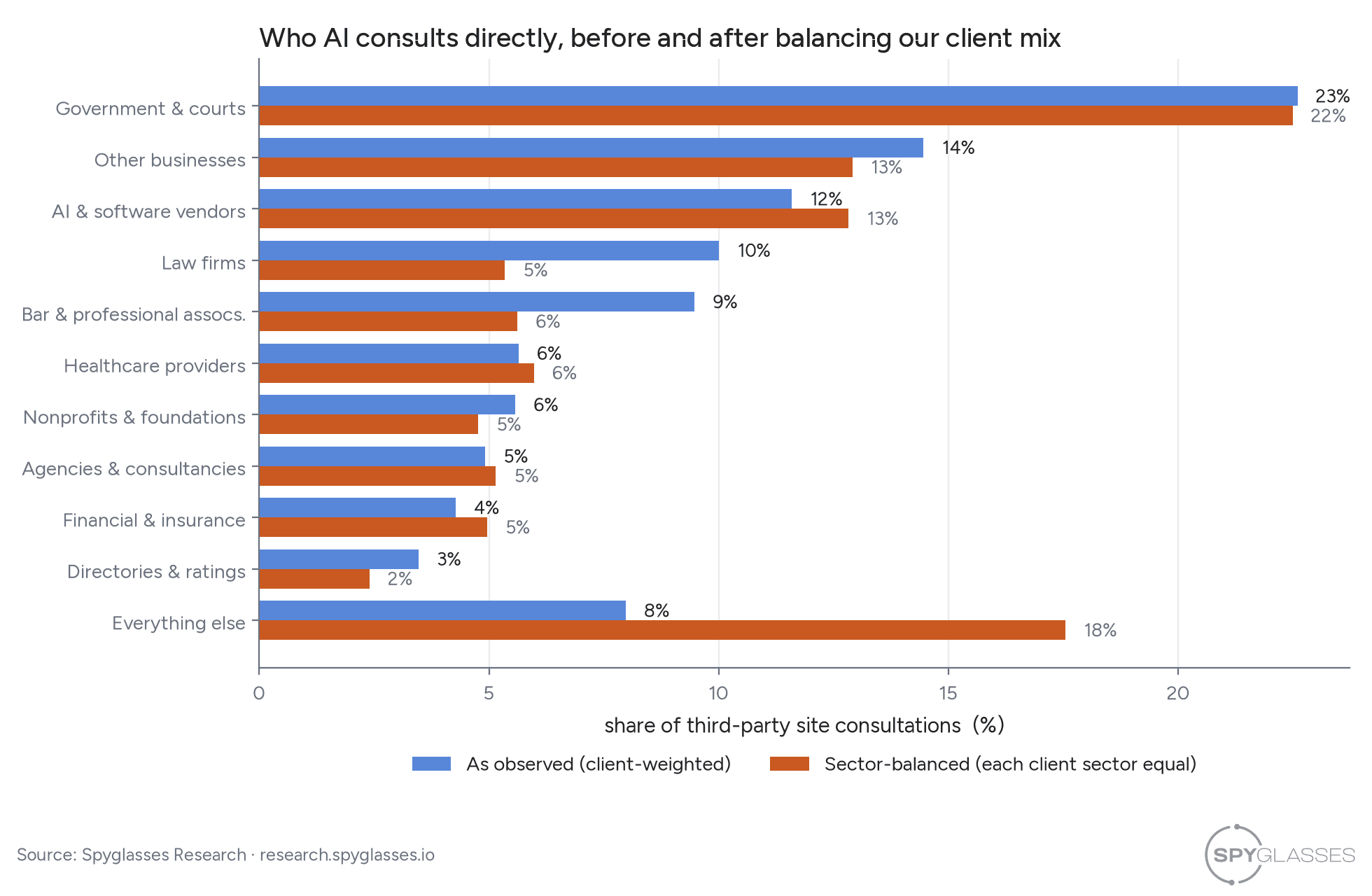
One caveat we checked carefully: our client base skews toward certain industries, so we re-weighted the data as if every client sector counted equally. The institutional pattern held. Government and courts stayed above 20% either way. This isn't an artifact of who uses Spyglasses; it's how the model behaves.
The biggest single slice, though, is ordinary businesses. Many of them are competitors our clients weren't tracking. AI found them, trusted them, and consulted them; the brands they compete with mostly have no idea. If you want to know who AI thinks your competitors are, the consultation list is the closest thing to a straight answer you'll get.
The authority club
We scored every consulted domain with our AI Placement Value Score and compared it against domains AI cited in the same answers but never consulted directly. The gap is large and consistent:
- Median AIPVS: 60 for consulted sites, 44 for cited-only sites.
- Premium and Strong tiers: 62% of consulted sites versus 41% of cited-only.
- Consulted domains sit far higher in the Common Crawl web graph; median rank around #485,000 versus #2.3 million.
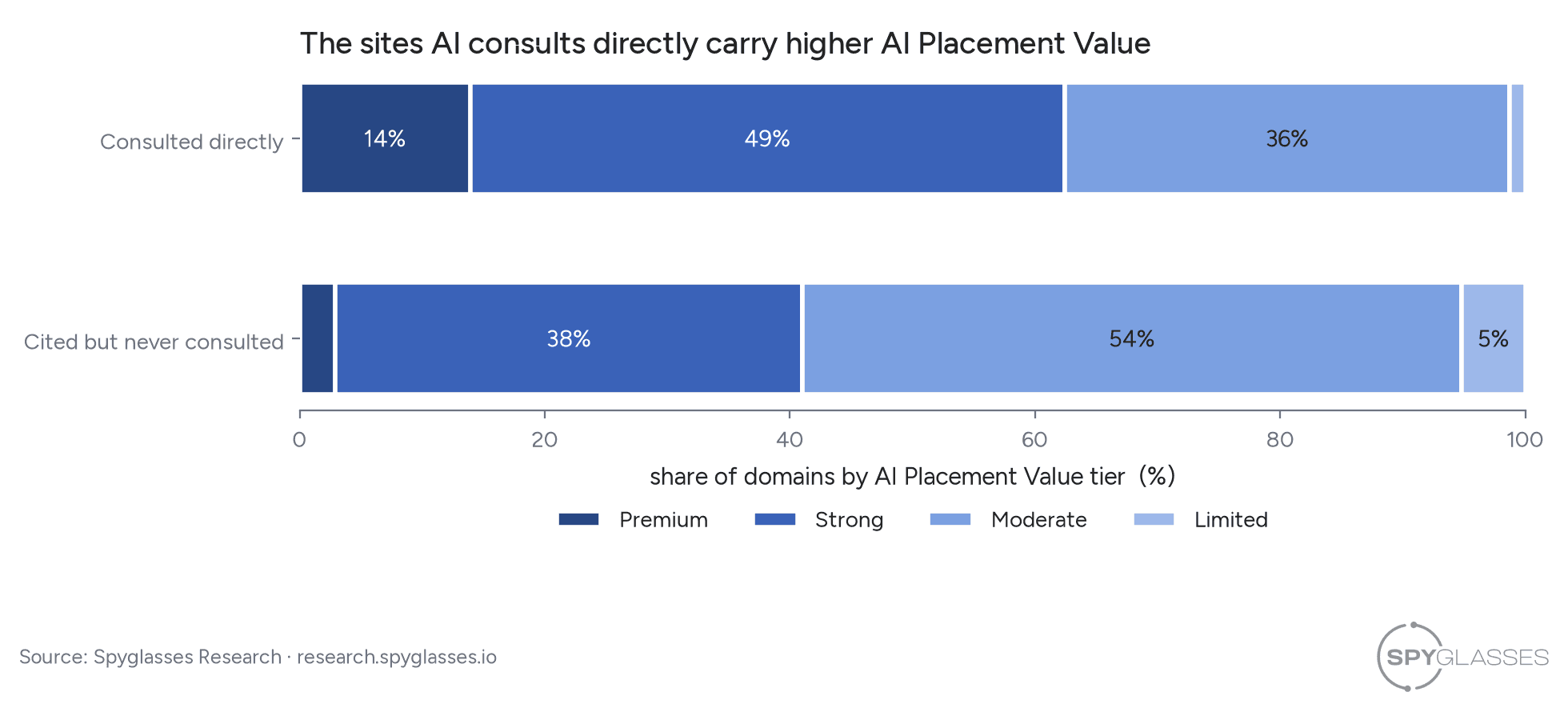
For PR teams, this is the earned-media implication: a placement on a site AI consults directly doesn't just reach that site's readers. It sits inside the source AI turns to first, before it even searches. When you're prioritizing outreach targets, the consulted list is a shortlist of publishers whose influence on AI answers is structural, not incidental.
Comparison questions send AI to the source
We also looked at which kinds of questions trigger direct consultations. The assumption in the industry (ours included, until we ran the numbers) was that asking about a brand directly sends AI to that brand's site. The data says otherwise.
Questions comparing brands triggered a direct consultation in 20% of answers. Questions about a single brand's identity? 9%. Generic category questions? 8%. When AI weighs one product against another, that's when it wants primary sources.
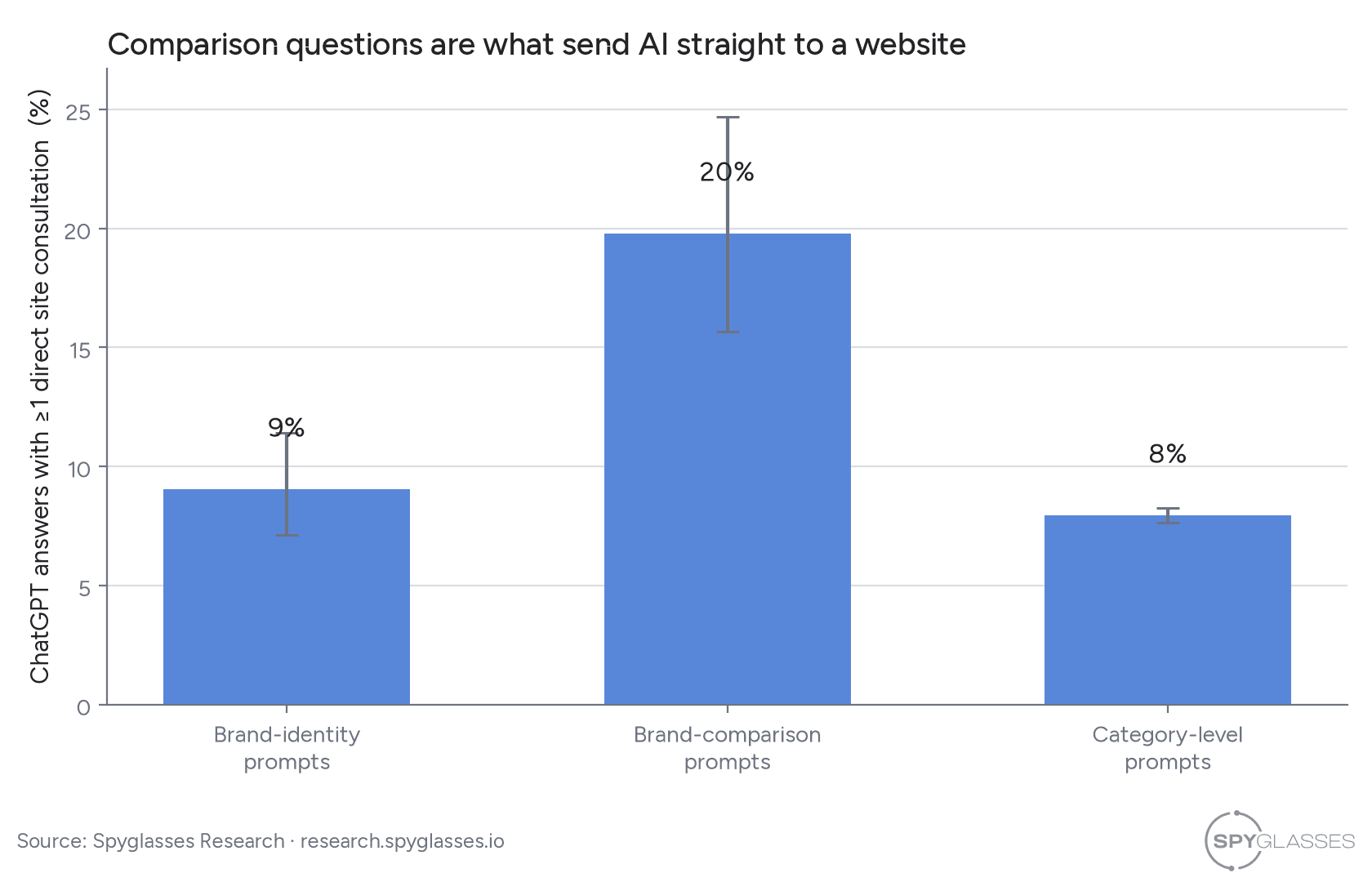
The takeaway for content teams is specific: publish comparison pages. Your product versus the alternatives, feature by feature, with real facts. Keep them factual and skip the superlatives; the page's job is to be the source AI consults when a buyer asks "X or Y?", and a sales pitch dressed as a comparison won't earn that trust. This is one of the few content moves with a direct, measured line to AI consultation behavior.
What to do with this
- Watch your consultations. The Brand Dashboard shows which sites AI consulted directly in your category, classified as yours, a competitor's, or a third party's. If AI is consulting a competitor you don't track, add them.
- Publish factual comparison pages. Comparison questions are the consultation trigger. Be the source worth consulting.
- Treat the consulted third parties as PR targets. Use Citation Intelligence to see which sources influence AI in your space, and prioritize the ones AI consults directly. Their AIPVS tells you what a placement there is worth.
- Don't panic about the institutional sites. You won't get a placement on a court website. But knowing that AI grounds your category in regulators and associations tells you which facts about your brand need to be consistent everywhere those institutions might reference.
The full methodology, the classification data, and what we can and can't claim from an observational design are in the research article.