Only One AI Answer Engine Points People to the Right Moment in Your Video

Jim Wrubel
7/13/2026
When an AI answer cites a YouTube video, does it point people to the part that actually answers their question? Or does it just drop a link to the whole video and leave them to scrub through it?
For most AI answer engines, the question doesn't even come up. They rarely put a video in the answer at all. But one engine does something the others don't: it links straight to the exact second. We pulled the numbers, and the gap between the leaders is bigger than we expected.
The finding
We looked at 5,405 YouTube videos cited by Google AI Overviews (evaluated in this study) and compared them with the videos cited by ChatGPT, Gemini, and Perplexity. Then we checked a simple thing: did the citation link include a timestamp, the kind that jumps you to 2:18 instead of the start of the video?
Google AI Overviews attached a timestamp to 44% of the YouTube videos it cited. The other three engines attached one to basically none.
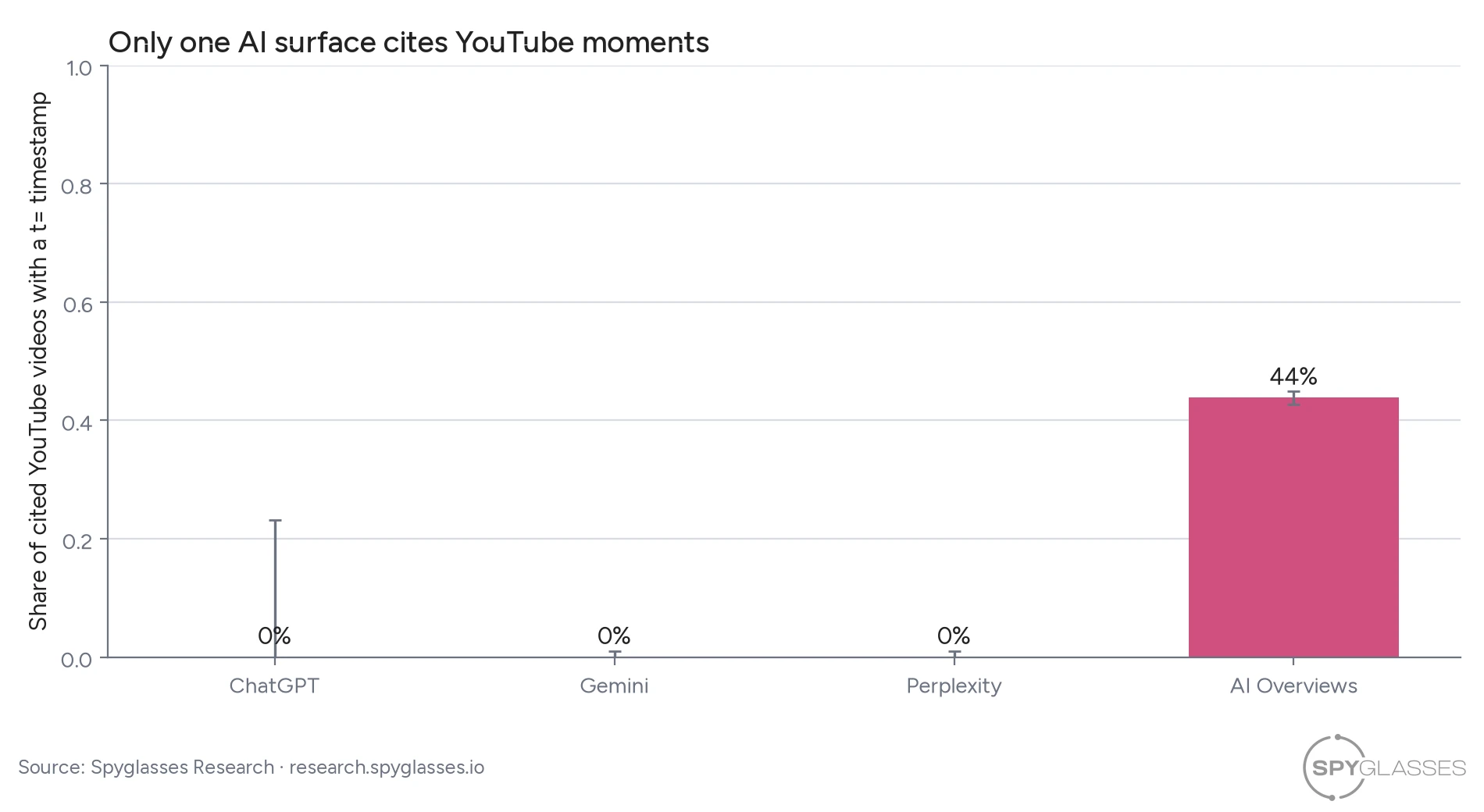
That Gemini shows the same flat zero is the part that surprised us. Gemini is a Google product. If any assistant were set up to inherit YouTube's own understanding of a video, it would be Gemini. It doesn't. Whatever produces these moment links lives in the Search and AI Overviews pipeline specifically, not in "Google" as a whole.
For anyone managing brand visibility in AI, that's the headline: if a video answers a buyer's question, Google's AI is currently the one surface that will carry people to the right spot in it.
Why the obvious playbook is wrong
Here's what most teams would guess about which videos get that treatment: the big channels, the ones with millions of subscribers and views. Authority wins, right?
The data says the opposite. Among the videos Google cited, the ones from smaller channels were a little more likely to get the moment link, not less. Less-viewed videos, too. When Google reaches for a precise moment, it's often reaching past the popular channels and into a specific answer buried inside a smaller creator's longer video.
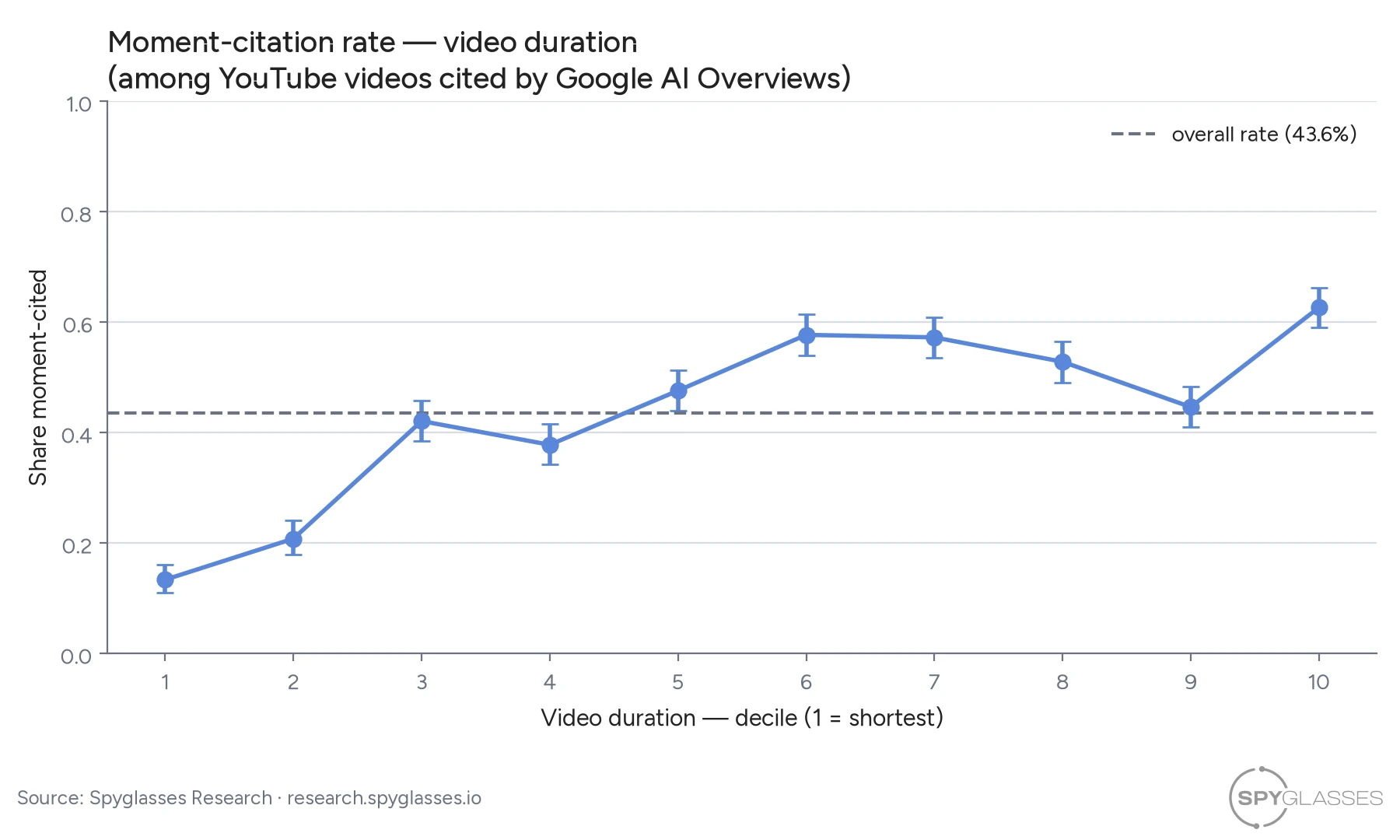
The strongest predictor by far was simply length. Long videos got the moment treatment far more often than short ones.
And the moments aren't coming from the chapters creators add to their descriptions. Only about 8% of the timestamps Google cited matched a chapter marker. The other 92% pointed at seconds the creator never labeled. Google is reading into the content of the video itself, not copying the signposts anyone could read.
What to do this quarter
If video is part of your or your clients' AI visibility plan, three moves follow from this.
Stop treating length as the enemy. The long, thorough video is exactly what gets deep-linked. If the goal is to be the source an AI answer points into, a comprehensive video with a genuinely useful middle beats a tight clip. That runs against the "cut everything to 60 seconds" instinct, and for AI discovery it should.
Don't wait to be the biggest channel. Google's moment links reach into smaller creators' videos at least as readily as large ones. A focused, expert video from a modest channel can win the moment. You don't need a million subscribers first.
Make the content legible to machines, not just the description. Chapters are fine hygiene, but they weren't the lever, and Google mostly isn't citing the moments you'd mark anyway. What matters is that the actual content is clear second by second: a clear spoken answer to a real question, and captions or an accurate transcript so the machine can read it.
A caveat
This measures the videos Google already chose to cite. It tells you which of those get the moment treatment; it doesn't prove that length or a smaller channel helps a video get cited in the first place. And only Google does this today. That could change as other engines catch up, which is exactly why it's worth watching now rather than after everyone does it.
The full write-up, with the method, the equivalence tests, and a downloadable dataset, lives on our research site: Only one AI surface deep-links to the moment inside a YouTube video.
See what AI says about your brand
Video is one channel in a bigger picture. Before you invest in it, it helps to know whether AI answers surface your brand at all, and where they're pulling their sources from. The Spyglasses AI Visibility Report runs your brand across ChatGPT, Gemini, Claude, and Perplexity and shows you what they say and cite. It's the fastest way to find out if the work you're doing is showing up where buyers now ask their questions.